
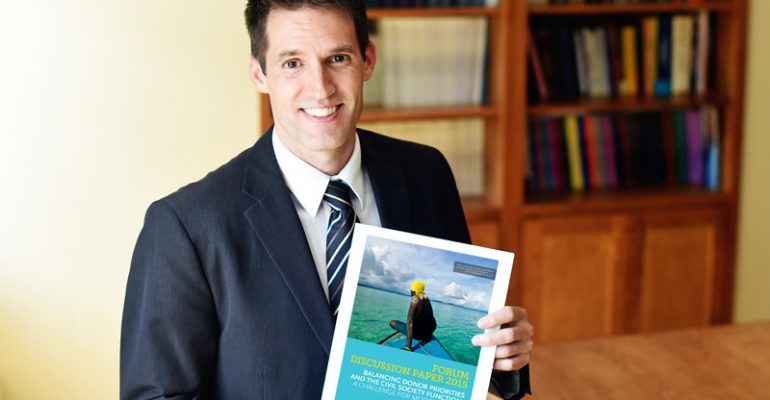
PRESS RELEASE: Forum Discussion Paper 2015
The International Forum for Volunteering in Development (Forum) today launched a research paper, Balancing Donor Priorities and the Civil Society Function: A Challenge for Modern IVCOs, examining how modern donor practices may challenge IVCOs’ alignment with the interests of civil society in partner countries—particularly in circumstances where a strong focus on service delivery and poverty eradication limit support for grassroots movements aimed at transformational structural and social change.
Authored by Benjamin J Lough of the School of Social Work in the University of Illinois, the paper seeks to unpack IVCOs’ relationships within contentious civic spaces and discusses ‘mission drift’ due to complex relationships with donors. It also addresses key questions arising from Forum member reports between 2004 and 2014, including: To what extent do we see IVCOs aligning with civil society interests and needs? Are IVCOs able to truly meet the needs of marginalised groups when funding comes primarily from State and private actors? Under what circumstances might it be appropriate for IVCOs to support controversial movements and advocate for civil society interests? What qualities do IVCOs and volunteers possess that allow them to be effective at strengthening co-productive relationships between governments and civil society?
Benjamin Lough, of the School of Social Work in the University of Illinois said:
“This paper was inspired through multiple discussions with community members as we’ve done research in the field. While most people express satisfaction with volunteers’ work others express frustration that their voices fail to catch the attention of decision-makers when these voices don’t align well with donors’ agendas. This paper discusses what IVCOs can do to support civil society in their efforts to change issues that matter most to them.”
Compared to other development actors, both public and private IVCOs claim advantages of closer alignment with local civil society organisations, people-centredness, participation and partnership-building.
Chris Eaton, Chair of the International Forum for Volunteering in Development and Executive Director of World University Service of Canada added:
“IVCO’s play a vital role in bridging the gap between donor understandings and interests, and the needs of local communities and organizations. Understanding why and where this gap exists is the first step towards closing it. This discussion paper makes an important contribution to this understanding.”
A key message of the UN Development Group’s strategy for delivering the post-2015 development agenda is to “proactively align multi-stakeholder priorities, including those of government, civil society, volunteers and private sector actors”.
Cliff Allum, Chair of Forum’s Research Working Group and CEO of Skillshare International research added:
“There has recently been a resurgence of interest in the role of international volunteers as agents of social change, where their role extends beyond the technical aspects of skills development and organisational capacity building to a broader understanding of their role as active citizens, a positive force in good governance, and contributors to the development of civil society. Ben Lough’s paper is an important contribution to this discussion, exploring the complex relationships between donor priorities for international volunteering and the role of volunteer organisations in relation to civil society. In so doing, it challenges notions and perspectives that seek to narrow the purpose of international volunteering and indeed international aid and development itself. With the growing attention on how volunteering for development is vital for the achievement of the new Global Goals, this paper has important messages about volunteer agency and donor practices if this is going to be successful.”
Read the Paper
Biography
Benjamin Lough earned his BS in Sociology in 2000 and his MSW in 2003 from Brigham Young University, and his PhD in 2010 from the George W. Brown School of Social Work at Washington University in St. Louis. Dr. Lough has extensive international research experience, having recently served as a resident consultant to the United Nations in Germany, an independent consultant to the Department of Human and Social Services of American Samoa, program evaluator for Mayan Tree in Guatemala, and program evaluator for the Foundation for International and Community Assistance in Armenia and the Republic of Georgia. In addition to considerable research and teaching experience, Dr. Lough also worked as a clinical social worker.